
What’s Really Happening to Your Trees This Summer?
Trees are constantly pulling water from their roots to their leaves, where it evaporates in a process called transpiration. Transpiration, similar to our perspiration, cools the tree down. When the soil is bone-dry and temperatures are pushing into the 90s or higher, your trees can’t keep up, and their internal systems start to break down.
Trees are pretty tough, but they all have their limits. Heat stress in trees causes growth to slow or stop entirely, and your trees become vulnerable to diseases and pests. In regions where temperatures swing rapidly in a matter of weeks, this stress can hit particularly hard and fast.
Early Warning Signs You Shouldn’t Ignore
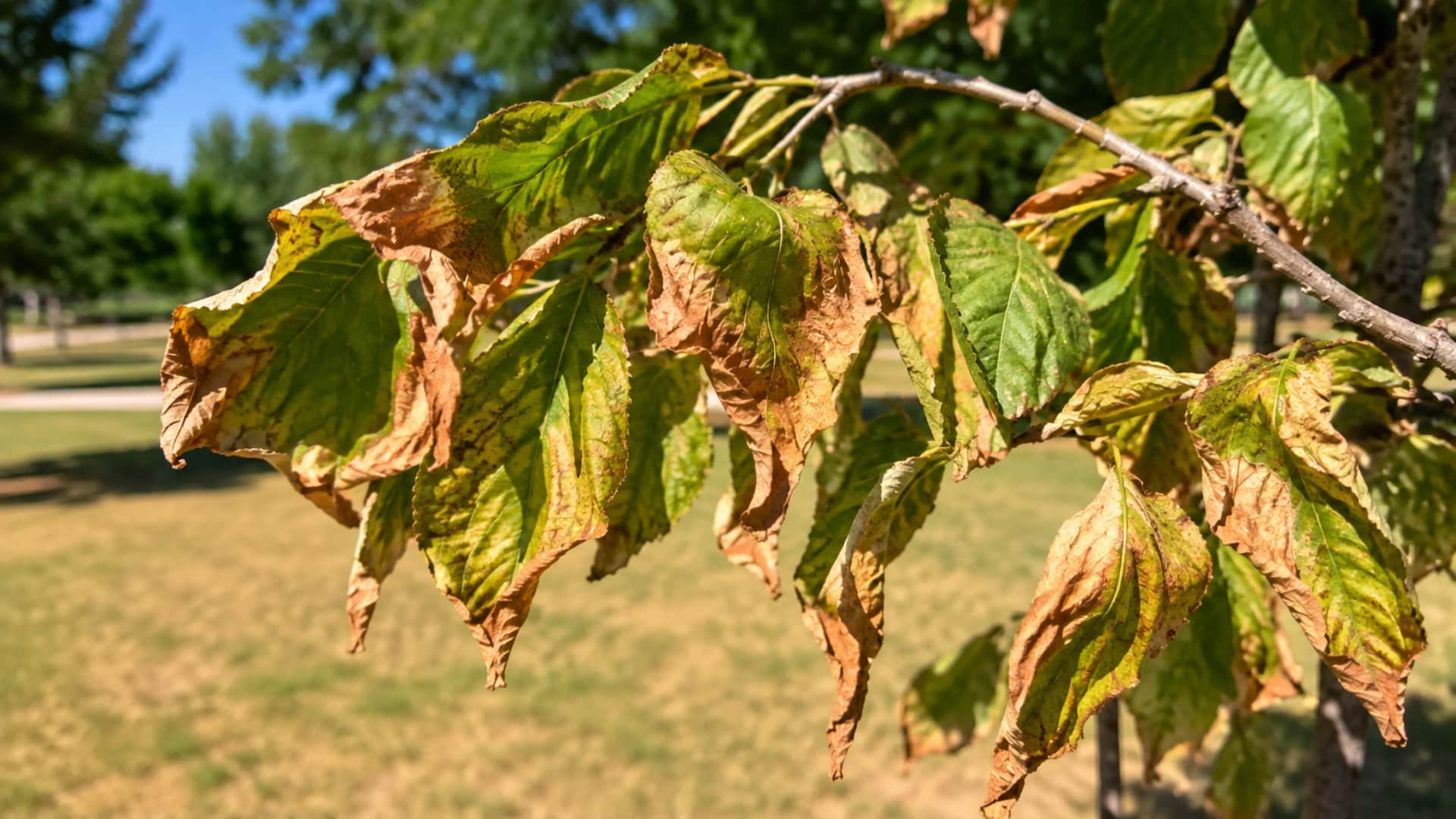
Your trees will tell you when they’re struggling. You just need to know what to look for:
- Wilting or drooping, especially on younger trees or newly planted specimens.
- Leaves curling inward or hanging limply even in the morning hours.
- Brown, crispy leaf edges, known as leaf scorch.
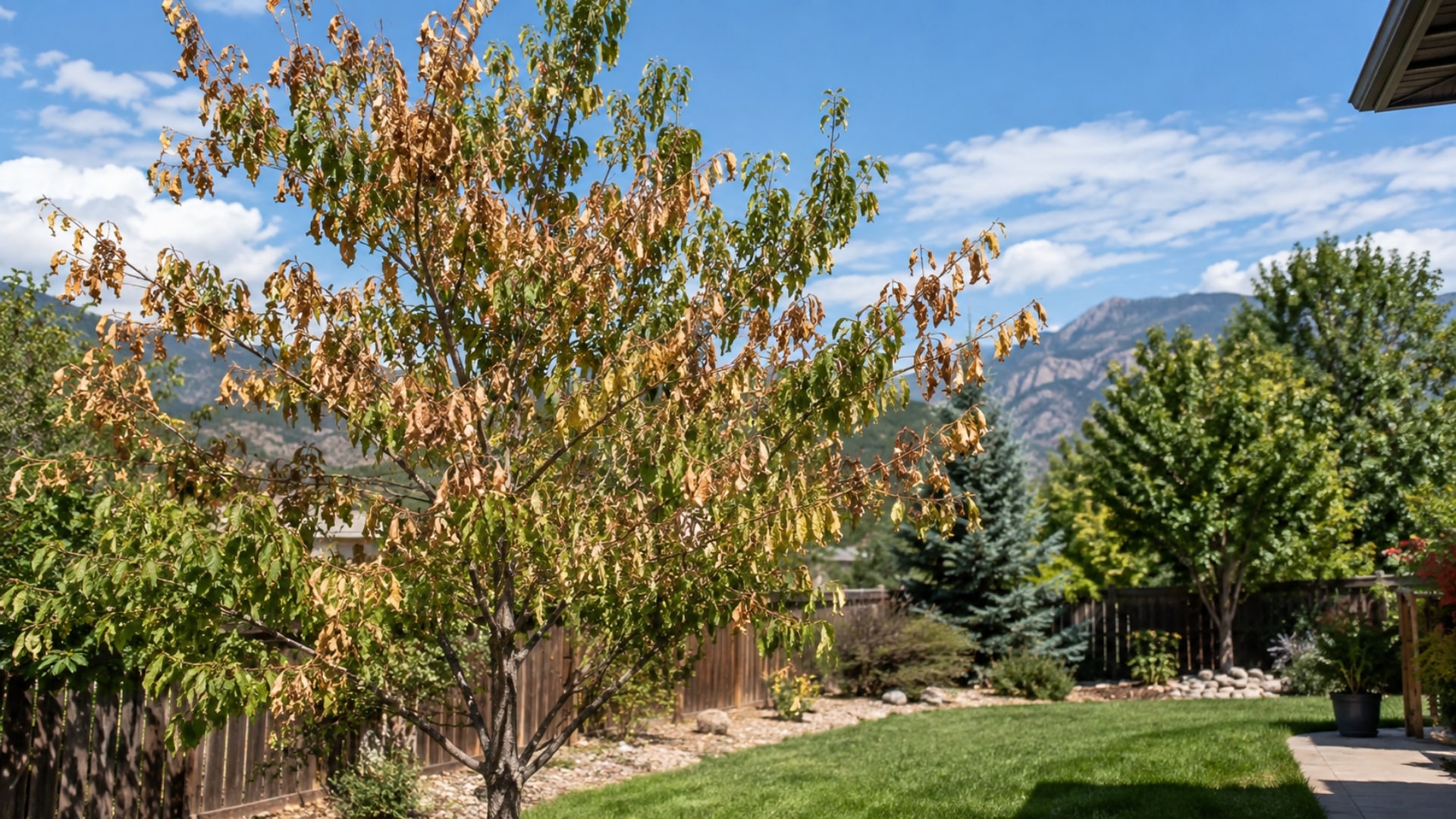
- Premature leaf drop in July or August.
- Stunted growth, with new shoots appearing smaller and weaker than previous years.
- Bark that’s cracking, splitting, or peeling away from the trunk.
The Domino Effect: What Happens After Heat Stress in Trees
A stressed tree is like a person with a weakened immune system, suddenly vulnerable to all sorts of problems that healthy trees would fight off easily. Bark beetles, which are already a massive problem in Colorado, absolutely love stressed trees. They can detect when trees are weakened, and they’ll target them with devastating efficiency.
Fungal diseases also take advantage of stressed trees, entering through bark cracks or damaged root systems. Root damage is particularly insidious because you can’t see it happening underground. When roots dry out and die back, your tree loses its anchor and its ability to absorb water and nutrients.
Over time, stressed trees will become progressively weaker and more dangerous. We’ve seen too many situations where a homeowner ignored the early signs of heat stress in trees. Within a year or two, that tree required emergency removal.
Related: Mountain Pine Beetles in Colorado Springs: How to Protect Your Trees in 2026
What Peak Tree Service Does Differently
When you call Peak Tree Service, owner Don Ruybal personally inspects your trees and provides same-day quotes, no waiting around for weeks wondering what’s wrong or what it’ll cost. With over 20 years serving Colorado Springs and more than 200 five-star reviews, we’ve seen every type of heat stress scenario imaginable.
We’ll walk your property with you, explain exactly what’s happening with your trees in plain language (no confusing jargon), and give you honest recommendations about what needs immediate attention and what can wait. Some companies will tell you to remove every tree that shows the slightest sign of stress. We don’t operate that way. If a tree can be saved, we’ll let you know.
Immediate Steps You Can Take Right Now
You don’t have to wait for professional help to start protecting your trees. Deep watering is your first line of defense: give your trees a slow, thorough soaking that penetrates 12-18 inches into the soil. Focus on the drip line; that’s the area directly under the outer edge of the canopy where the feeder roots are most active. Mulching around your trees can also help retain soil moisture and keep roots cooler.
Avoid fertilizing stressed trees. It sounds counterintuitive, but fertilizer forces new growth that the tree can’t support when it’s already struggling. You should also hold off on any major pruning during peak heat unless you’re removing dead or dangerous branches. Stressed trees need every healthy leaf they have to produce energy.
Heat Stress in Trees: When to Call for Professional Assessment
Any sign of significant stress warrants a professional inspection. Waiting too long can turn a manageable problem into an expensive emergency:
- Large sections of dead branches throughout the canopy are a red flag.
- Trees that show sudden, dramatic decline.
- Leaning trees or trees with cracks in the trunk.
- Bark falling off in large sections or you see sawdust around the base (a sign of boring insects).
- Trees near your home, power lines, or areas where your family spends time.
At Peak Tree Service, we know tree problems don’t wait for convenient timing, so we make ourselves available Monday through Saturday, 7 AM to 9 PM.
The Real Cost of Waiting
A proactive tree health assessment and treatment plan might cost you a few hundred dollars. Waiting until that stressed tree dies completely and becomes a hazard? You’re looking at thousands in emergency removal costs, especially if the tree is large, near structures, or requires specialized equipment. Insurance won’t cover removing a dead tree you knew was declining; they consider that maintenance, not an unexpected event. If a tree falls on your home, you’re going to be responsible.
Waiting also creates safety risks. Dead trees and large dead branches don’t announce when they’re going to fall. They come down during windstorms, under snow load, or due to gravity. We’ve responded to too many emergency calls where a falling tree or branch damaged a home, crushed a vehicle, or worse. Most of those situations were preventable with early intervention.

Long-Term Tree Health in a Changing Climate
Colorado’s climate is changing, and summer heat stress is becoming more frequent and more severe. Tree care in Colorado Springs isn’t what it was 20 years ago. We’re seeing stress patterns and pest pressures that were uncommon when Peak Tree Service first started in 2008. We’ve had to evolve our approach to tree care, and so will you.
If you’re planning to plant new trees on your property, it’s a really good idea to select native, drought-resistant species; these include the Ponderosa Pine, the Rocky Mountain Juniper, the Bigtooth Maple, the Gamble Oak, and the Common Hackberry. Drought-resistant trees will be better equipped to handle the weather ahead.
Proper watering during establishment (the first 2-3 years after planting) can also mean the difference between a tree that thrives for decades and one that struggles from day one. We help our clients think long-term about their landscapes, not just about the immediate problem in front of them.
You May Also Like: Stressed Pine Trees Colorado Springs: How to Identify and Address Tree Stress
Save Your Trees Before Summer Heat Strikes Again
Your trees have been through a lot, and with summer heat becoming more intense each year, the time to act is now. At Peak Tree Service, Don will personally inspect your property and provide a detailed quote during the same visit: no waiting, no runaround, no pressure. We’re fully licensed and insured, so you have complete peace of mind. Whether you’re dealing with obvious heat damage or you just want a professional assessment to catch problems early, we’re here to help.
Don’t wait for heat stress in trees to become dangerous. Reach out to Peak Tree Service today and experience the difference that local knowledge, honest communication, and quality workmanship make. You won’t regret it; that’s our promise to you.
FAQs: Heat Stress in Trees
How do I know if my tree is suffering from heat stress or if it's dying?
Heat-stressed trees typically show wilting leaves, brown leaf edges, and premature leaf drop during summer months, but they still have some green, living tissue in the canopy and flexible branches. A dying tree will have large sections of completely dead branches, bark falling off in chunks, and may show signs of pest infestation like sawdust at the base. If you’re unsure about your tree’s condition, contact Peak Tree Service for a free professional assessment.
Can a heat-stressed tree recover, or will it eventually die?
Many heat-stressed trees can recover with proper care, including deep watering, mulching, and reducing additional stressors like pruning or fertilizing during peak heat. Recovery depends on the severity of the damage, the tree species, and how quickly you intervene. Trees caught early often bounce back within one to two growing seasons. However, severely stressed trees that have suffered extensive branch dieback or pest infestations may not recover.
How often should I water my trees during a Colorado Springs heat wave?
During extreme heat, you should deep-water your trees once or twice per week, applying water slowly so it penetrates 12-18 inches into the soil rather than running off the surface. Focus on the drip line area (the ground directly under the outer edge of the canopy) where feeder roots are most active, and water in early morning or evening to minimize evaporation. Newly planted trees and non-native species may need more frequent watering, while established native pines and spruces are more drought-tolerant but still benefit from supplemental watering.
Related posts:
 Stressed Pine Trees Colorado Springs: How to Identify and Address Tree Stress
 Drought Tree Care Colorado Springs: How Dry Conditions Affect Your Trees
 Spring Tree Inspections in Colorado Springs: Pre-Season Checklist for Pikes Peak Homeowners
 Dead Tree Removal in Colorado Springs: Why Immediate Action Protects Your Home